
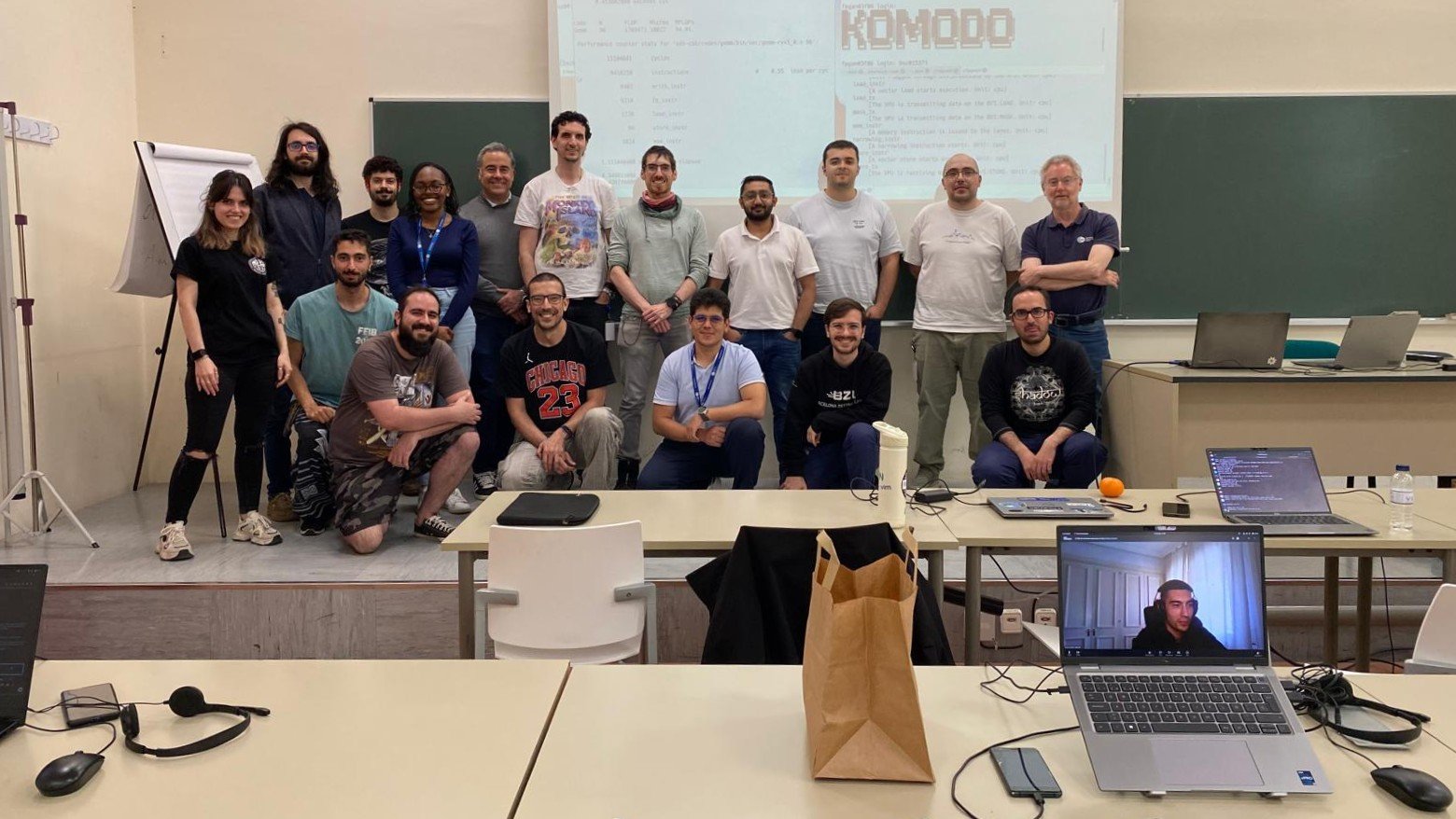
On May 14, the Barcelona Zettascale Lab (BZL) team successfully concluded its third internal RISC-V hackathon, titled “Keep-on-Going,” continuing the progress achieved in previous editions and further advancing its experimental HPC ecosystem based on RISC-V architectures.
The hackathon focused on hands-on experimentation with the BZL FPGA infrastructure and the Komodo–Lagarto Ox RISC-V platform. Participants worked with dual-core Lagarto Ox configurations, vector-enabled setups, OpenMPI environments, and a broad range of HPC development and benchmarking tools, including LLVM/Clang-23, GCC 14.2, Extrae, PAPI, and HPL benchmarks.
Compared to earlier sessions, the event demonstrated significant improvements in the platform’s stability and usability. Participants successfully carried out RISC-V cross-compilation workflows, validated vectorized MPI executions, and executed benchmark suites such as RAJA, NEMO dwarfs, Lanczos, and SDV-CAB. The hackathon also made progress toward running COMPSs directly on Ubuntu over the RISC-V environment, although some network-related issues still affected distributed runtime execution.
Overall, the third BZL RISC-V Hackathon validated substantial progress in the development and usability of the Komodo–Lagarto Ox FPGA platform and its associated software ecosystem. The event confirmed improved FPGA stability, successful execution of multiple HPC workloads, functional vectorization support in several scenarios, and the increasing maturity of the RISC-V software stack for HPC experimentation.
At the same time, participants identified areas requiring further work, particularly regarding VPU stability, correctness verification for large benchmark inputs, incomplete support for certain vector instructions, network stability affecting distributed runtime execution, and broader software ecosystem integration involving FORTRAN, HDF5, and COMPSs support.
The organizers acknowledged the contributions of Daniel González, Rohan Ahmed, and Juan Miguel de Haro for their support throughout the hackathon activities, as well as the ongoing efforts of the BZL team in continuously improving the platform infrastructure.
Building on the progress achieved during these sessions, preparations are already underway for the next edition of the RISC-V Hackathon series, which is expected to further expand the capabilities of the BZL experimental HPC and RISC-V ecosystem.